Archive / Industrial heritage1909 — 2023
Industrial memory
Clausolles factory, home of La Clandestina de Poblenou.
01 / The origins1909 — 1916

Archive — Plans for buildings for the Valls, Teixidor, Jordana y Cía. factory
The Clausolles factory
The company Valls, Teixidor, Jordana y Cia. — founded in April 1909 by Camil Valls, Ignasi Teixidor, Eugeni Jordana, Josep Maria Macià and Antoni Novals — bought a plot of land bordering Carrer Pere IV from the cotton-print manufacturer Lluis Pellerin, in order to set up a factory for medical articles and products. The building project was signed by the industrial engineer Emili Lluch; all that survives of it today are the chimney and the warehouses next to Carrer Pere IV, whose somewhat Modernista façades still display the medical crosses that referred to the company's business. The firm presented itself as heir to the former J. Clausolles company, a significant detail given the pioneering role played by the Clausolles family.
Around 1913, following the loss of one of its founding partners, the company was renamed Valls, Jordana y Cia., and after the death of another, Camil Valls, the firm S. A. Clausolles was finally established in January 1916.
Born as the successor to the previous company and driven by Eugeni Jordana — who was in charge of its management — the new firm had a capital of 2,500,000 pesetas and, like its predecessors, continued to claim the business legacy of the Clausolles name.

Archive — Share of the Sociedad Anónima Clausolles

Archive — Aerial view of Poblenou
02 / A new chapter for the factory complex1955 — 1967
New warehouses
The purchase of the factory in 1955 by Metales y Plateria Ribera, S.A. marked the start of a new chapter for the factory complex, now as a property investment to be let out. In the year of the purchase, the firm Pané, S.A., while occupying the premises, carried out — with the Riberas' approval — a major refurbishment of the site, building a new group of warehouses inside it.
Around 1960 the owners began dividing up the premises, with part of them occupied by Domingo Cantí's textile business.
From 1967 the firm Helios Tratamientos Térmicos occupied most of the new warehouses; its activity led to constant complaints from neighbours about the pollution they had to endure.
03 / Decline and last industrial activity1980 — 2016
Years of decline
In the years that followed, the premises housed a good number of small businesses with very diverse activities. After Metales y Plateria Ribera went into receivership in the mid-1980s, the factory complex began a process of severe decline, which worsened over the next decade and ultimately led to the demolition of much of the original 1909 buildings. At the start of the new century, the company Construcciones Metálicas Tryfyme set up a metalwork shop there, which remained active until the business was wound up in 2016.

Archive — Carrer Pere IV, 1980
04 / La Clandestina de Poblenou2019 — today
A new chapter
The current phase of transformation, in line with what has been happening at other factory complexes in Poblenou, began in 2019 when the La Clandestina de Poblenou Cultural and Creative Association began, step by step, to open the space to the neighbourhood, programming cultural and creative activities, workshops, markets and socio-cultural events.
In addition, supporting entrepreneurship became an important activity for the space from 2020 onwards, with the opening of shared workspaces and the hosting of projects as diverse as they are creative and innovative.
05 / Activity record2019 — 2023
Activity record
2019
December 2019
FOUNDING OF LA CLANDESTINA
The association begins its activities

2020
January 2020
RECOVERY OF COMMUNITY SPACES
February 2020
CULTURAL ACTIVITIES
Cultural activities begin, such as markets, live music and creative workshops
March 2020
CREATION OF THE EL HUASILLO GARDEN
Clearing rubble and building raised beds
May 2020
SHARED WORKSPACES
Shared workspaces set up to support entrepreneurship among local creators.

2021
February 2021
AGREEMENT WITH FUNDACIÓ JOIA
Collaboration agreement to run creative workshops.

May 2021
JOINING TAULA EIX PERE IV
Formal membership of the Taula Eix Pere IV

June 2021
CREATION OF A NATURALISED POND
With advice from Fundación Galanthus Natura, a naturalised pond is built in the El Huasillo garden.

June 2021
ESPAI DE MEMÒRIA PROJECT WITH AHPN
A project in collaboration with the Arxiu Històric del Poblenou to recover the historical memory of the former Clausolles factory.

2022
January 2022
PLÀSTIC PRECIÓS BARCELONA JOINS
Plàstic Preciós Barcelona joins La Clandestina de Poblenou as a resident project to promote sustainability and raise awareness of it

February 2022
AGREEMENT WITH SEMILLAS FITÓ
Agreement with Semillas Fitó to improve and adapt the El Huasillo garden

2023
January 2023
ARTIST RESIDENCY AGREEMENT
Agreement with R.A.R.O. (Residencias Artísticas Raramente Organizadas) to carry out temporary and itinerant artist residency projects.

March 2023
REFUGI CLIMÀTIC PROJECT
A project promoted by the Laboratori d'Emergències Urbanes (LEMUR) to create a climate shelter in the garden.

May 2023
POBLENOU FÀBRICA/FABRICA
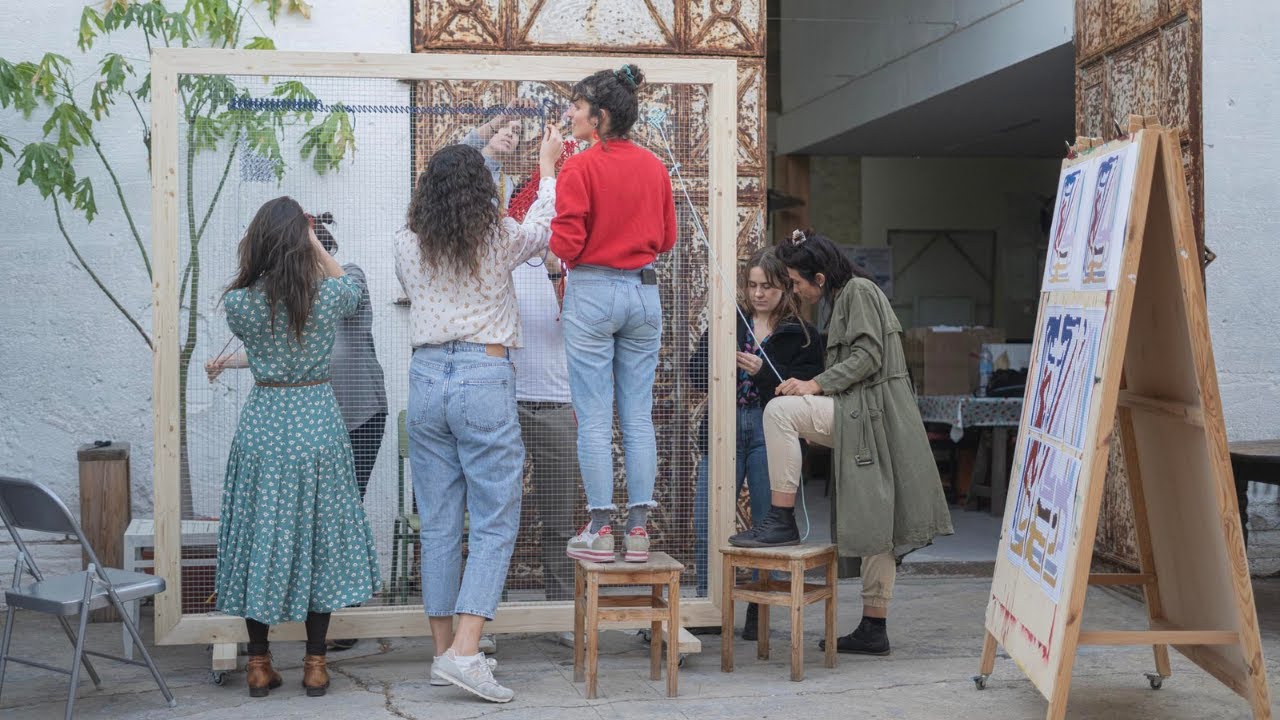
Participation in Fab Lab Barcelona's exhibition-laboratory at Ca l'Alier on Poblenou's industrial past and craft present. La Clandestina, together with resident artists Sonia Benitez Textile Studio and Atómica Rugs, created a collective embroidery action.
November 2023
TALLERS OBERTS
Participation in the 2023 edition of Barcelona's Tallers Oberts (Open Studios) initiative, organised by A-FAD (Associació d'Artistes i Artesans).

06 / A story that continues2019 — today
A story that continues.
The former industrial complex remains a living space today, dedicated to creation, experimentation and the sharing of knowledge.
Since 2019, La Clandestina has worked to maintain these spaces and give them new uses, welcoming a range of artistic, craft and design disciplines.